
Baroda BNP Paribas ESG Best-in-class strategy Fund
NFO Period: February 12, 2026 – February 26, 2026
The Baroda BNP Paribas ESG Best-in-class strategy Fund is a thematic equity scheme designed to capture growth in companies prioritizing sustainable practices. By focusing on ESG leaders, the fund aims for long-term capital appreciation through a disciplined, high-standards investment approach.
| Scheme Type | Open-ended equity scheme following ESG theme adopting Best-In-Class Strategy |
|---|---|
| Benchmark | Nifty 100 ESG TRI |
| Min. Investment | Rs. 1,000 and in multiples of Re. 1 thereafter |
| Min. Additional | Rs. 1,000 and any amount thereafter |
Investment Strategy
The fund employs a “Best-in-Class” strategy, actively selecting companies within the Indian equity market that demonstrate superior Environmental, Social, and Governance performance compared to peers. This approach aims to mitigate sustainability risks while capitalizing on the efficiency and resilience of ESG leaders.
Who Should Invest
- Investors seeking long-term capital growth.
- Those looking to align portfolios with ESG values.
- Investors with a 5+ year time horizon.
Who Should Avoid
- Investors seeking short-term liquidity.
- Conservative investors looking for fixed returns.
- Those uncomfortable with thematic equity volatility.
Portfolio & Benchmark Analysis
Top 10 Holdings: Nifty 100 ESG TRI (as of Dec 31, 2025)
| Company Name | Weight (%) |
|---|---|
| Reliance Industries Ltd. | 9.85% |
| HDFC Bank Ltd. | 9.12% |
| Infosys Ltd. | 8.45% |
| ICICI Bank Ltd. | 7.90% |
| Tata Consultancy Services Ltd. | 6.20% |
| Hindustan Unilever Ltd. | 4.15% |
| Axis Bank Ltd. | 3.80% |
| Larsen & Toubro Ltd. | 3.50% |
| Kotak Mahindra Bank Ltd. | 3.10% |
| ITC Ltd. | 2.95% |
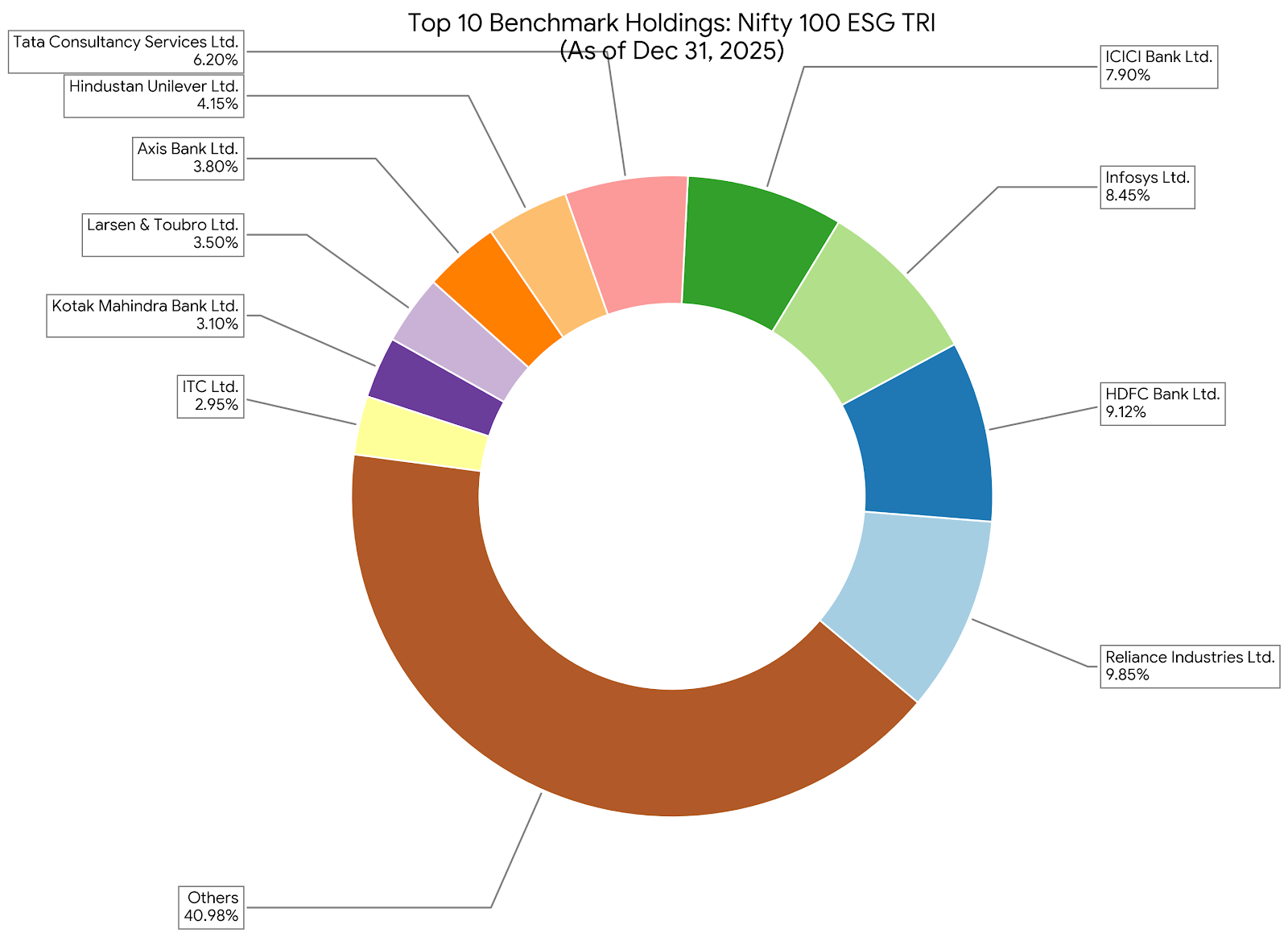
Source: Internal Research and NSE Data. Data as of Dec 31, 2025.
Benchmark Comparison: ESG vs. Standard
| Metric | Nifty 100 ESG TRI | Nifty 50 |
|---|---|---|
| Sector Focus | ESG Compliant Sectors | Broad Market Top 50 |
| Risk Mitigation | High (ESG Filters) | Standard |
| Volatility (Avg) | Moderate | Standard |
Historical Performance (Benchmark)
Return analysis of Nifty 100 ESG TRI vs Nifty 50 as of December 31, 2025.
| Period | Nifty 100 ESG TRI (CAGR) | Nifty 50 (CAGR) |
|---|---|---|
| 1 Year | 21.4% | 19.8% |
| 3 Year | 16.2% | 15.5% |
| 5 Year | 14.8% | 14.2% |
| 10 Year | 13.5% | 13.1% |
NFO Investment & Delay Calculator
See the impact of starting your SIP now vs. waiting.
*Assumed rate of return: 12% p.a. (As per SEBI standards). This is for illustrative purposes only.
Frequently Asked Questions
What is the investment objective of the Baroda BNP Paribas ESG Best-in-class strategy Fund?
The fund aims to achieve long-term capital appreciation by investing in companies that meet high Environmental, Social, and Governance standards in India.
Who can invest in Baroda BNP Paribas ESG Best-in-class strategy Fund?
Resident individuals, HNIs, and institutional investors seeking thematic exposure to ESG leaders with a long-term horizon can invest.
What is the minimum amount for Baroda BNP Paribas ESG Best-in-class strategy Fund?
Investors can start with a minimum initial investment of Rs. 1,000, and additional investments of Rs. 1,000 thereafter.
How is the Baroda BNP Paribas ESG Best-in-class strategy Fund benchmarked?
The scheme is benchmarked against the Nifty 100 ESG Total Return Index (TRI), which tracks the performance of companies with high ESG scores.
Is Baroda BNP Paribas ESG Best-in-class strategy Fund an open-ended fund?
Yes, it is an open-ended equity scheme, allowing investors to subscribe and redeem units on any business day after the NFO period.
 Sushil Bajaj
  +91 931-5120-004
