
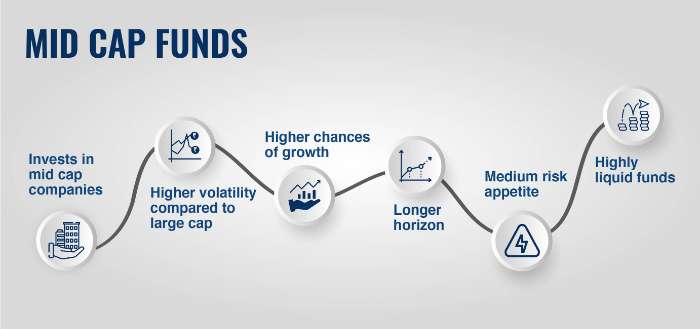
For the equity mutual funds, growth paired with stability are typically the aims for the investors. For this reason, the Mid Cap Mutual Funds are the most appropriate investment, as the funds are invested in corporations having the market capitalization between 101–250. The mid-cap entities offer the larger potential for yield in contrast to the large-cap entities but are less risky than the small-cap funds.
If you are interested in investing in the top mid cap mutual funds, then this guide will provide you an idea about their features, advantages, disadvantages, and things to consider prior to investing.
Data based on index weightage as of January 31, 2026.
| Rank | Company Name | Sector | Weightage (%) |
|---|---|---|---|
| 1 | BSE Ltd. | Financial Services | 3.07% |
| 2 | Hero MotoCorp Ltd. | Automobile and Auto Components | 1.93% |
| 3 | Federal Bank Ltd. | Financial Services | 1.90% |
| 4 | Persistent Systems Ltd. | Information Technology | 1.76% |
| 5 | IndusInd Bank Ltd. | Financial Services | 1.58% |
| 6 | Suzlon Energy Ltd. | Capital Goods | 1.55% |
| 7 | Indus Towers Ltd. | Telecommunication | 1.54% |
| 8 | PB Fintech Ltd. | Financial Services | 1.51% |
| 9 | Ashok Leyland Ltd. | Automobile and Auto Components | 1.51% |
| 10 | Cummins India Ltd. | Capital Goods | 1.49% |

Comparison of trailing returns and risk metrics as of January 31, 2026.
| Period / Metric | Nifty Midcap 150 TRI | Nifty 50 TRI |
|---|---|---|
| 1 Year Returns | 32.45% | 18.12% |
| 3 Year CAGR | 26.80% | 15.40% |
| 5 Year CAGR | 21.15% | 14.25% |
| Standard Deviation (Risk) | 18.4% | 14.2% |
| Sharpe Ratio | 1.22 | 0.85 |
*Standard Deviation and Sharpe ratio calculated on a 3-year trailing basis.

| Mid Cap funds are appropriate for investors who: |
|---|
| Have a moderate risk tolerance – higher risk than large-cap but lower than small-cap funds. |
| Investing for 5+ years for long-term wealth generation. |
| Desire to begin investing in small sums (SIP from ₹500 onwards). |
| Endure volatility in the market for the prospect of earning higher returns. |
When choosing the top mid cap mutual funds, the following are to be considered:


The future large caps can be the midcaps today, generating huge wealth in the long run.
Investment in various mid-size companies minimizes the risk concentration.
Invest from as little as ₹500 through SIP.
SEBI requires disclosure of NAVs, expense ratios, and portfolios.
Choose between Lump Sum (₹1,000 minimum) or SIP (₹500 monthly).

Like all equity funds, mid cap funds come with risks:
| Liquidity Risk | Market Risk | Increased Expenses |
|---|---|---|
| Mid caps are less liquid than large-cap stocks, thus exits are tougher in volatility within the market. | Mid-cap companies are relatively sensitive to the economy and are exposed to higher volatility. | Expense ratios can be higher because more research has to be conducted to find growth areas. |
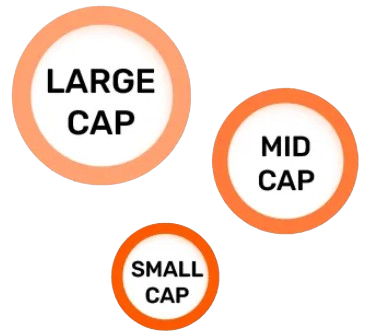
| Fund Type | Risk Level | Return Potential | Suitable For | Investment Horizon |
|---|---|---|---|---|
| Large Cap | Low | Moderate | Conservative investors | 3–5 years |
| Mid Cap | Moderate | High | Moderate risk-takers | 5–7 years |
| Small Cap | High | Very High | Aggressive investors | 7+ years |

Source: National Stock Exchange, Advisorkhoj Research, as on 30th September 2025.

Yes, mid-cap funds are appropriate for investors who want long-term growth along with moderate risk. They can give performance better than large caps in favorable market conditions.
Mid-cap companies are usually in the size range of market capitalization between ₹5,000 crores to ₹20,000 crores.
You can start small with ₹500 SIP or invest via a lump sum of ₹1,000 or more.
They are riskier than big-cap but less risky than small-cap stocks. For moderate risk-takers who are in for the long haul, they are a well-balanced choice.
Yes, mid cap funds are ideal for investors looking to build wealth over 5–7 years due to their strong growth potential.

Mid Cap Mutual Funds provide neither too much growth nor excessive risk and are thus suitable for moderate-risk-oriented investors. As they can give large-cap funds a run for their money in the long term, they are most appropriate for investors who can remain invested for 5–7 years. Investors can create wealth gradually through SIP or lump sum if they opt for funds that are well-managed, show consistent performance, and are reasonably priced.
Disclaimer
This article is for informational purposes only and does not constitute financial advice. Before investing, you should consult a qualified financial advisor, consider your risk tolerance, investment horizon, and review the latest scheme documents, factsheet and disclosures from Mutual Fund.
📅 Last Updated on: February 17, 2026
 Sushil Bajaj
 Fund Analytics ARN-48012 Registered Distributor All Schemes Large Cap Mid Cap Small Cap Flexi Cap Tax Saver (ELSS) Fund Information Latest NAV 1Y Return 3Y Return 5Y Return 10Y Return Analysis Syncing Nivesh Sansar Database… Status: Ready Prev Page 1 Next 📅 Last Updated on: April 4, 2026
Choice Nifty 50 Index Fund NFO | Invest Online Overview Strategy Portfolio Performance FAQs Invest Now Overview Choice Nifty 50 Index Fund is a passive investment vehicle designed to replicate India’s top 50 companies’ performance. It provides cost-efficient exposure to large-cap equities. Ideal for long-term investors seeking stable index-linked growth. Category: Index Fund NFO Dates: […]
© Copyright 2025 - All Rights Reserved | Website developed by Behind Methods Co.
 +91 931-5120-004
