

Investors frequently face a classic question: how to access market growth without risking their hard-earned capital? Mutual funds offer various alternatives, but one emerging area is the Capital Appreciation Transfer Plan (CATP). This is for those wishing to take advantage of the upside potential of the equity market while keeping the capital portion unaffected.
In this blog we will discuss what a CATP is, how it works, advantages, who it is suitable for, and a real-life example to illustrate the concept.

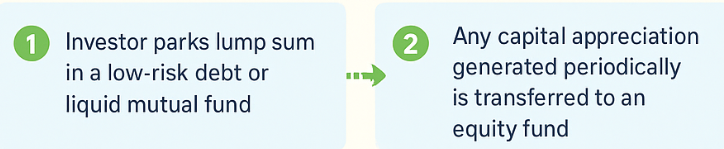
A Capital Appreciation Transfer Plan is a system introduced by many mutual fund houses, which only transfers the capital appreciation (profit) of total investment from one mutual fund scheme to another. For instance, if an investor has placed a lump sum in a low-risk debt or liquid fund, the capital appreciation that occurs on this lump sum investment will be systematically transferred to an equity fund.
Unlike a systematic transfer plan (STP), where a fixed amount is transferred systematically, in CATP an investor only transfers the profits leaving the capital unaffected in the debt fund.
To put it plainly:
Capital = Safe in Debt
Profits = Move to Equity for Growth
Here’s a step-by-step breakdown:
Over time, the equity portion grows systematically, building wealth while preserving the safety of the original capital.


Capital Protection
Your capital or principal remains intact in a safer debt fund.
Market Exposure with Safety
Only your profits are used to invest in the equity markets, limiting the risk.
Disciplined Investing
All gains are then automatically re-invested, instilling a disciplined habit of wealth-building.
Two Benefits
It offers the security of debt but the opportunity for growth within equity.
Comfort for the Investor
It provides peace of mind to a risk-averse investor knowing their core money is never risked, in exposure to volatility.

Let’s understand with a simple example:

At the end of a year, your principal ₹10,00,000 remains in the debt fund, while around ₹70,000–₹75,000 (depending on returns) has been invested into equity.
So, your portfolio now has:
This way, you enjoy market participation without worrying about your capital security.

The Capital Appreciation Transfer Plan provides a sensible smart, hybrid, approach for conservative investors. It provides an opportunity for growth while provide peace of mind knowing they are still safe. For anyone hesitant towards entering into equity exposure, CATP presents a structured approach to enter without a banking on equity market timing.
If you have a lump sum and want to grow wealth safely, CATP could be a perfect fit. As always, it’s best to discuss with a financial advisor before implementing, to align with your personal goals.


Disclaimer:- Mutual Fund investments are subject to market risks, please read scheme related documents carefully before investing.
📅 Last Updated on: September 29, 2025
 Sushil Bajaj
 Abakkus Large & Mid Cap Fund NFO 2026 | Invest Online Overview Strategy Portfolio Performance FAQs Invest Now Abakkus Large & Mid Cap Fund NFO Period: Jul 15, 2026 – Jul 29, 2026 | Large & Mid Cap Investment Objective: To generate long-term capital appreciation through a portfolio predominantly invested in equity and equity related […]
Baroda BNP Paribas Services Fund NFO | Invest Online Overview Strategy Portfolio Performance FAQs Calculator Invest Now Baroda BNP Paribas Services Fund – NFO 2026 NFO Period: July 14 – July 28, 2026 | Category: Thematic – Services Actively managed equity fund targeting long-term capital appreciation from companies engaged in the services theme. Invest in […]
© Copyright 2025 - All Rights Reserved | Website developed by Behind Methods Co.
 +91 931-5120-004
