

An open-ended index mutual fund NFO by DSP Asset Managers designed to replicate/track the Nifty Smallcap 250 Index. The fund’s primary aim is to provide returns that closely correspond to the total returns of the benchmark index, subject to tracking error. The NFO subscription window opened on 24-Nov-2025 and closed on 08-Dec-2025 (NFO period).

A Nifty Smallcap 250 Index Fund is a passively managed equity mutual fund that tracks the Nifty Smallcap 250 Index, representing the small-cap segment of the Indian equity market.
The index comprises 250 companies ranked from 251 to 500 by market capitalisation within the Nifty 500 universe. These small-cap companies are typically in their growth or expansion phase, offering higher long-term growth potential but also higher volatility.
Key features of a Nifty Smallcap 250 Index Fund
| Field | Detail |
|---|---|
| Fund name | DSP Nifty Smallcap 250 Index Fund (NFO) |
| Fund house | DSP Mutual Fund (DSP Asset Managers) |
| Type | Open-ended index equity fund (NFO) |
| Benchmark | Nifty Smallcap 250 TRI (total return index) |
| NFO period | 24-Nov-2025 to 08-Dec-2025. |
| NFO price | ₹10 per unit (typical NFO pricing). Minimum application often ₹100 for lump sum/SIP as per NFO documents. |
| Objective | Replicate/track Nifty Smallcap 250 index returns (subject to tracking error). |
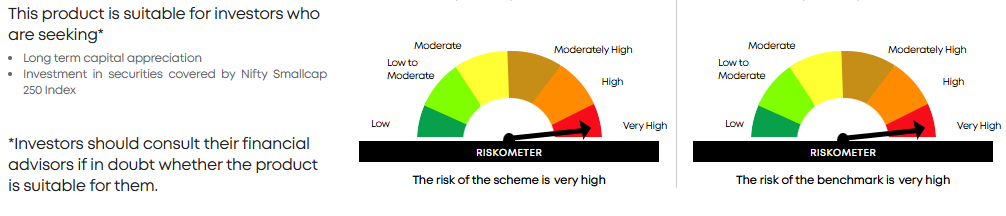
| Risk profile | Very High (Small-cap equity). DSP KIM / Riskometer shows “Very High” for scheme & benchmark. |
| Suitability | Long-term investors (at least 5–7+ years), high risk tolerance. |

The official objective of DSP Nifty Smallcap 250 Index Fund is:
The primary objective is to generate returns that are commensurate with the performance of the Nifty Smallcap 250 TRI, subject to tracking error. The fund will attempt to replicate the index by investing in the same stocks in similar weights, while managing transaction costs and cash holdings. (Text reflects DSP/SEBI filings.)
Benchmark Index: Nifty Smallcap 250 Index
Potential reasons (pros):
Potential drawbacks (cons):
Tracking error risk: Implementation and rebalancing costs can cause divergence from index returns.
High volatility & drawdowns: Smallcaps historically show larger swings than mid/large caps.
Liquidity risk in underlying stocks: Some constituents may be thinly traded.
Replication approach: The fund is an index fund aiming to replicate the Nifty Smallcap 250 index. Typical strategies an index fund manager will use:
Tracking error drivers: transaction costs, cash holdings, timing differences during rebalances, corporate actions, and liquidity constraints in smaller stocks.
Operational considerations for smallcap index funds: small-cap constituents may have lower daily liquidity and higher bid-ask spreads — leading to potentially larger tracking error and higher implementation cost versus large-cap index funds. DSP has launched this product to offer passive exposure to this under-represented index segment.

Expense Ratio: Check latest factsheet.
Exit Load: Usually none for index funds, or minimal for short-term redemption
Taxation:
🔗 How to Invest Online?
Smallcap funds (especially index ones) can face challenges. Here’s a table summarizing common pain points and how this fund or investors might mitigate them:
| Investor pain-point | How this fund / approach addresses it | Practical tip |
|---|---|---|
| High cost of active small-cap funds | Index funds generally charge lower TERs vs active funds — reduces cost drag over time. | Compare expense ratios before investing. |
| Lack of diversification when picking small caps | Nifty Smallcap 250 provides exposure to 250 companies across sectors. | Use as a core allocation or complement to active picks. |
| Liquidity concerns in smaller companies | Fund will hold a broad basket and may manage liquidity; however, underlying stocks can be illiquid. | Use SIP for phased exposure; avoid panic selling on drawdowns. |
| Tracking error worries | DSP will aim for low tracking error via replication/sampling techniques; expect some difference due to costs & cash. | Review scheme’s historical tracking error (once available) and read the KIM/SID. |
| Volatility & drawdowns | Smallcap segment is volatile — investors may face larger drawdowns. | Maintain long time horizon (5–10+ years) and avoid market timing. |

A1: No. This is a very high risk equity small-cap index fund. Suitable only for investors with high risk tolerance and long investment horizons (≥5–7 years).
A2: An index fund tracks the index rules and holdings; an active fund’s manager selects stocks attempting to beat the benchmark (with typically higher fees). DSP’s NFO targets index returns (minus costs).
A3: As per NFO details, the NFO price was ₹10/unit and minimum investment for lump sum and SIP was small (e.g., ₹100) — confirm exact minimums in the KIM/form.
A4: The fund may use full replication or sampling depending on liquidity and cost. KIM/SID explains the replication approach DSP plans to use

The DSP Nifty Smallcap 250 Index Fund (NFO) offers a low-cost, rules-based way to access a diversified basket of 250 small-cap Indian companies via an index product. It may suit investors who want passive small-cap exposure as part of a long-term, high-risk portion of their portfolio. However, investors should be prepared for high volatility, possible liquidity constraints in some constituents, and tracking error relative to the benchmark.
Disclaimer
This article is for informational purposes only and does not constitute financial advice. Past performance is not a guarantee of future returns. Before investing, you should consult a qualified financial advisor, consider your risk tolerance, investment horizon, and review the latest scheme documents, factsheet and disclosures from DSP Mutual Fund.
📅 Last Updated on: December 16, 2025
 Sushil Bajaj
 Axis Nifty Capital Markets Index Fund NFO – Invest Online Overview Strategy Portfolio Performance FAQs Invest Now Axis Nifty Capital Markets Index Fund The Axis Nifty Capital Markets Index Fund is a low-cost passive investment solution designed to capture the growth of India’s evolving financial ecosystem. By tracking the Nifty Capital Markets TRI, it offers […]
Invesco India Nifty Bank Index Fund NFO – Invest Online Overview Strategy Portfolio Performance FAQs Invest Now Invesco India Nifty Bank Index Fund Invesco India Nifty Bank Index Fund is a strategic passive investment solution that allows investors to track the performance of India’s leading banking institutions. By replicating the Nifty Bank Index, it offers […]
© Copyright 2025 - All Rights Reserved | Website developed by Behind Methods Co.
 +91 931-5120-004
