
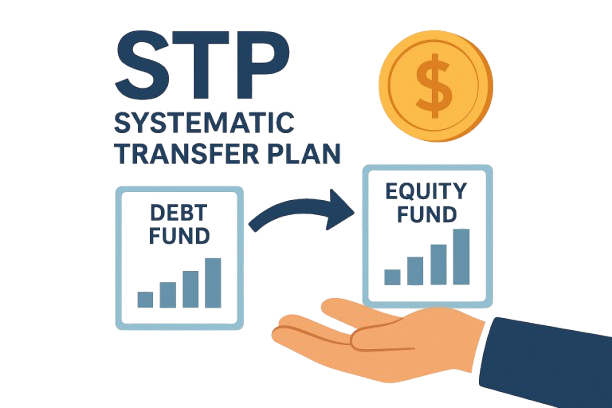
Investors often look for a balance between safety and growth when managing their portfolios. A Systematic Transfer Plan (STP) in mutual funds offers just that – a structured way to move money from one scheme to another at regular intervals. This not only helps maximize returns but also reduces risks and keeps investments aligned with financial goals.
Whether you want to shift gradually from a debt fund to an equity fund or vice versa, an STP provides a disciplined approach to wealth creation.
A Systematic Transfer Plan allows investors to transfer a fixed amount of money from one mutual fund scheme (source fund) to another (target fund) within the same fund house at pre-decided intervals (daily, weekly, or monthly).
👉 Think of it as the reverse of a Systematic Investment Plan (SIP).

Suppose you have parked ₹10,00,000 in a debt fund but wish to enter an equity fund. Instead of transferring the entire lump sum at once, you can set up an STP to shift, say, ₹50,000 every month into the equity fund. This reduces exposure to market volatility and helps in cost averaging.


Manage Volatility – Reduces risk of investing lump sum during market highs.
Cost Averaging – Like SIPs, STPs average out purchase cost.
Better Returns – Debt funds generate returns till money is transferred into equities.
Liquidity Management – Keeps part of the money in safer debt funds while shifting gradually.
Tax Efficiency – Usually fewer taxable events compared to manual redemptions and reinvestments.

Q1. How does an STP help during volatility?
By spreading investments over time, STPs reduce the risk of entering the market at a wrong level and allow cost averaging.
Q2. What is the full form of STP?
STP stands for Systematic Transfer Plan.
Q3. Is STP better than SIP?
Both serve different purposes. SIP suits investors investing fresh money regularly. STP is for investors who already have a lump sum and want to invest gradually.
Q4. Can I decide the transfer amount in STP?
Yes, you can fix or modify the transfer amount as per your goals.
Q5. What are the transfer frequency options?
Daily, weekly, monthly, or quarterly – depending on what your AMC offers.

A Systematic Transfer Plan (STP) is a smart investment tool for those holding lump sums but wishing to invest gradually. It offers risk management, disciplined investing, and potential for better returns. For beginners or seasoned investors, STPs can be an effective way to balance safety with growth.


Disclaimer:- Mutual Fund investments are subject to market risks, please read scheme related documents carefully before investing.
📅 Last Updated on: October 9, 2025
 Sushil Bajaj
 Abakkus Large & Mid Cap Fund NFO 2026 | Invest Online Overview Strategy Portfolio Performance FAQs Invest Now Abakkus Large & Mid Cap Fund NFO Period: Jul 15, 2026 – Jul 29, 2026 | Large & Mid Cap Investment Objective: To generate long-term capital appreciation through a portfolio predominantly invested in equity and equity related […]
Baroda BNP Paribas Services Fund NFO | Invest Online Overview Strategy Portfolio Performance FAQs Calculator Invest Now Baroda BNP Paribas Services Fund – NFO 2026 NFO Period: July 14 – July 28, 2026 | Category: Thematic – Services Actively managed equity fund targeting long-term capital appreciation from companies engaged in the services theme. Invest in […]
© Copyright 2025 - All Rights Reserved | Website developed by Behind Methods Co.
 +91 931-5120-004
