How Trump Tariffs Threaten India’s Economy and Mutual Fund Investors
How Trump Tariffs Threaten India’s Economy and Mutual Fund Investors
Trump Tariffs on India: What Are They
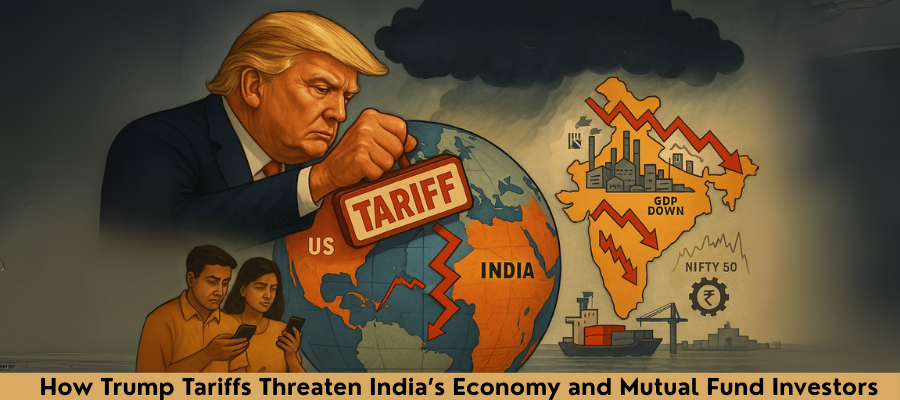
President Donald Trump implemented reciprocal tariffs on Indian imports to the U.S. First a 25% tariff, and then an additional 25% penalty for a total duty of 50% on many products.
The justification provided by the U.S. was India’s continued purchase of Russian oil and imposed trade practices.
Exceptions—industries like pharmaceuticals and electronics qualify to other tariffs either partially or fully.
Trump Tariffs Impact on the Indian Economy
Here are the major economic effects:
1, Export Losses in Key Sectors:
Sectors hit hardest include textiles, gems & jewellery, shrimp, leather, industrial chemicals, furniture. These are labour-intensive and often rely on U.S. demand.
Some estimates suggest the export drops in the affected goods sections will be near catastrophic levels. For example, GTRI estimates that exports from the affected industry could see a drop all the way up to ~70%.
2. Job Uncertainty and the Employment Effect:
Because many of these industries impacted are labour reliant, millions of jobs are at risk in the near term.
3. Trade Balance and Global Competitiveness:
These tariffs will lessen the price competitive nature of Indian goods to U.S. Imports, and in effect, give competitive advantages to competing exporters (Vietnam, Bangladesh, etc.).
India will likely see a downturn for export orders and the firms will either absorb cost increases (squeezed margins) or lose market share.
4. Effect on GDP Growth:
The Chief Economic Adviser of India believes that tariffs could reduce India’s GDP growth by about 0.5-0.6% in FY26.
Economists at HDFC Bank estimate that the impact of the tariffs could lower growth by approximately 40 basis points (0.4%).
5. Effects on Currency & Sentiment:
The rupee has weakened, in part, due to fears of trade/export losses.
Foreign Portfolio Investors (FPIs) have become tentative, reducing some positions as there is uncertainty.
6. Government Solutions and Buffering Action:
India is looking at potential relief measures for affected exporters.
There is a push for exporters to diversify markets and encourage domestic manufacturing to minimize dependence on weak export sectors.
Source: The Guardian, Financial Times, Reuters, The Economic Times, ICICI Direct
Impact on the Indian Mutual Fund Industry
It affected in several ways. Here are the main channels and what investors/fund houses should watch:
1, Sectoral Exposure Risk:
Funds with large weights in export sectors such as textiles, gems & jewellery, leather, etc., have exposure to the declines. These funds will face drops in return if export volumes decline or margins compress.
Sectoral funds or thematic funds with weights in those areas will also struggle. Mutual funds replicating export-heavy indices will also experience greater volatility.
2. Nav Volatility:
Since the earnings of impacted companies are uncertain, pricing in those sectors will be penalized and NAVs of funds holding impacted companies will experience volatility.
Since foreign investor sentiment tends to affect the broader market as well, a pullout on behalf of FPIs could introduce some volatility in the entire equity fund sphere.
3. Fund Flows / Redemption Pressure:
If damaged export sectors continue, retail investors may redeem investments from funds with poor short‐term performance. Redemption pressure can then emerge for mutual fund houses, especially for those whose portfolios are heavily exposed to some of the puffed-up export sectors.
4. Portfolio Rebalancing:
Fund managers are likely to reduce sector weights and lower exposure to sectors most adversely impacted by tariffs issued by the United States. They might redistribute capital to other sectors, for example, more resilient domestic sectors (e.g. consumption, banking, pharmaceuticals, etc.).
Diversification gains: funds that have broad sector or index exposure will least likely offer superior returns than concentrated funds.
5. Long Term vs Short Term Outlook:
In the short-term, there is likely to be discomfort: volatility, earnings pressure in some sectors, possibly lower returns for funds heavily exposed.
In the long term, in the case of this being the new policy backdrop, however, we may see eventual rerouting of supply chains, increased competitiveness in domestic sectors, or the possibility of finding alternative export markets to the United States. Funds that allocate capital in expectation of any of these factors may be able to exploit the economic environment moving forward.
6. Advice to Investors / Strategies:
For Quote: Continue performing Systematic Investment Plans (SIPs) in the business of investing rather than converting large lumpsum amounts.
Check on what portion of your fund’s investment is vested in sectors related to exports, or exportable goods.
Allocates more to funds/portfolios that have less dependency on exports, as well as those that are more positively biased toward domestic demand.
Source: The Guardian, Financial Times, Reuters, The Economic Times, ICICI Direct, Al Jazeera, ION
Trump’s tariffs raising U.S. import duties on many Indian goods to 50% pose a significant risk to India’s export sectors, competitiveness, and growth in FY26.
The economy is expected to lose some GDP growth, both due to direct export losses and negative sentiment / investment effects.
For the mutual fund industry, the biggest effects will be in funds with exposure to export-dependent sectors, with NAV volatility and possible underperformance in the short run. However, diversified funds and domestic-oriented sectors may provide a buffer.
Disclaimer:- Mutual Fund investments are subject to market risks, please read scheme related documents carefully before investing.
Abakkus Large & Mid Cap Fund NFO 2026 | Invest Online Overview Strategy Portfolio Performance FAQs Invest Now Abakkus Large & Mid Cap Fund NFO Period: Jul 15, 2026 – Jul 29, 2026 | Large & Mid Cap Investment Objective: To generate long-term capital appreciation through a portfolio predominantly invested in equity and equity related […]















 Sushil Bajaj
  +91 931-5120-004
