

When it comes to mutual fund investments, one of the most common dilemmas investors face is choosing the right fund category. Many worry about market volatility, risk of capital erosion, or whether they will achieve long-term goals like retirement and children’s education. If you are looking for stability, steady growth, and relatively lower risk, then a Large Cap Fund is the right choice.
When we talk about “large cap funds”, we’re referring to mutual fund schemes that invest primarily in large‐capitalization companies — companies that are generally well-established, have strong market presence, and command a significant market‐cap in their sector. These funds give investors access to major players in the stock market, rather than smaller or newer firms.
In India, large cap funds typically benchmark themselves to indices that represent the top companies by market cap (for example, the NIFTY 50 or BSE 100 TRI).
Why does this matter? Because large cap funds offer a blend of growth potential and stability — they are not as volatile as small caps, but still have meaningful upside if the underlying companies keep performing. Think of them as a steady high-way rather than rough back roads.

| Large cap funds are ideal for investors who: |
|---|
| Have a medium to long‐term horizon (say 5+ years) and want to build wealth steadily. |
| Want exposure to equity markets but prefer relatively lower risk than what smaller or mid‐cap funds entail. |
| Are looking for a core equity holding in their portfolio — something to anchor their investments. |
| Are comfortable with market fluctuations, but prefer more established companies. |
If you are just starting out, or if you have a very conservative risk profile (say you cannot tolerate any loss), then you may want to combine large cap funds with other asset classes (like debt or hybrid funds). But if you’re someone who says “I’m in this for the long haul and want decent equity exposure”, large cap funds could be your friend.
Choosing a benchmark is important because it tells you what the fund is being measured against. For large cap mutual funds in India, commonly used benchmarks are:
Why total return (TRI)? Because it includes both price changes and dividends — which gives a fuller picture of returns.
When you compare a large cap fund’s performance, always compare it against its benchmark (same time-horizon, same type of return) to judge how well the fund manager has done.
| Time Horizon | Return |
|---|---|
| 1 Year | 6.48% (31 Oct 2025) |
| 5 Years | 18.88% (31 Oct 2025) |
| Since Inception | 17.02% (31 Oct 2025) |


When choosing the top large cap mutual funds, the following are to be considered:

Here are some compelling benefits that make large cap funds attractive:
Large cap companies tend to be more mature and stable than smaller ones, which translates to somewhat lower volatility.
You get the growth potential of equities but within a somewhat safer bracket compared to very small or unproven companies.
Instead of picking individual stocks in large cap companies, you get access to a diversified basket managed by professionals.
They can serve as a backbone of your equity portfolio — providing stability while you may add higher-risk/higher-reward funds (like mid-cap) around them.
Many fund houses offer large cap funds with low minimums via SIP, making them accessible for retail investors.
No investment is risk-free — large cap funds carry their own set of risks, and you should be aware:
| Market Risk | Overvaluation Risk | Fund-Manager Risk |
|---|---|---|
| Even large cap companies are part of the market. If the overall market falls, large cap stocks will also fall (though perhaps less sharply than smaller stocks). | If large cap stocks become overvalued (i.e., high price vs fundamentals), future returns may be lower. | The fund’s actual performance depends on how well the manager picks stocks, times the market, manages risk. If the manager changes or moves strategy, risk can increase. |
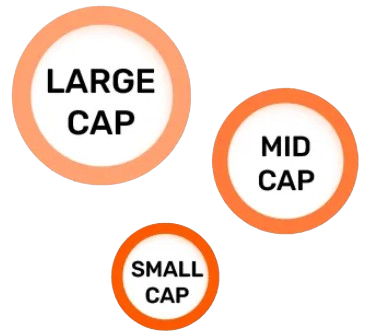
| Fund Type | Risk Level | Return Potential | Suitable For | Investment Horizon |
|---|---|---|---|---|
| Large Cap | Low | Moderate | Conservative investors | 3–5 years |
| Mid Cap | Moderate | High | Moderate risk-takers | 5–7 years |
| Small Cap | High | Very High | Aggressive investors | 7+ years |

Investors seeking steady growth with risk lower than that of the mid and small-cap funds may opt for large-cap funds.
At least 5-7 years ideally, in order to ride through market cycles and experience compounding.
Large Cap Funds are safer and more stable, whereas Mid and Small Cap Funds can give higher returns but are associated with higher volatility.
Yes, SIPs are the ideal means of investment in large cap funds and wealth accumulation on a systematic basis.
Performance is variable, but ICICI Prudential Large Cap Fund and Nippon India Large Cap Fund rank among the best in 2025.

Large Cap Fund is a smart choice for investors who want stability, consistency, and long-term wealth creation without taking excessive risk. Whether you are a beginner or a seasoned investor, adding large-cap funds to your portfolio can help you balance growth with security.
Disclaimer
This article is for informational purposes only and does not constitute financial advice. Before investing, you should consult a qualified financial advisor, consider your risk tolerance, investment horizon, and review the latest scheme documents, factsheet and disclosures from Mutual Fund.
📅 Last Updated on: November 3, 2025
 Sushil Bajaj
 Abakkus Large & Mid Cap Fund NFO 2026 | Invest Online Overview Strategy Portfolio Performance FAQs Invest Now Abakkus Large & Mid Cap Fund NFO Period: Jul 15, 2026 – Jul 29, 2026 | Large & Mid Cap Investment Objective: To generate long-term capital appreciation through a portfolio predominantly invested in equity and equity related […]
Baroda BNP Paribas Services Fund NFO | Invest Online Overview Strategy Portfolio Performance FAQs Calculator Invest Now Baroda BNP Paribas Services Fund – NFO 2026 NFO Period: July 14 – July 28, 2026 | Category: Thematic – Services Actively managed equity fund targeting long-term capital appreciation from companies engaged in the services theme. Invest in […]
© Copyright 2025 - All Rights Reserved | Website developed by Behind Methods Co.
 +91 931-5120-004
